
SR&ED for software development: what qualifies and the record we keep
The test CRA applies to software work, the work it leaves out, and how we keep the record during a build so the client’s SR&ED preparer has what they need.

Software work qualifies for SR&ED when it tries to resolve a technological uncertainty that the available knowledge cannot answer, through a systematic investigation: a hypothesis, tests and conclusions, with evidence kept as the work goes. Routine programming, routine testing and features built with known techniques stay outside. The record kept during the build is what makes a claim possible.
INNOVA keeps that record while it builds the software. Write to us about your project.
The test CRA applies
CRA’s guidelines on the eligibility of work ask two things of any project, software included.
- Why the work was done. It has to aim at a scientific or technological advancement by resolving an uncertainty. CRA treats an uncertainty as present when it is unknown whether a result can be reached, or how, because the knowledge available falls short: what the business already knows and what is reasonably available to the public. Success or failure does not decide it.
- How the work was done. It has to be a systematic investigation by experiment or analysis: a hypothesis, tests of it, logical conclusions, and evidence kept as the work progresses.
A team that meets an uncertainty and goes around it with a workaround built from known methods has done development work, and CRA does not count it.
Software work, in and out
CRA lists computer programming as support work. It counts only when it directly supports eligible experimental development, and only as much as that work needs. Its guidelines exclude, among others:
- quality control and routine testing of products or processes;
- routine data collection;
- style changes;
- commercial production of a new or improved product, and commercial use of a new or improved process;
- market research and sales promotion.
In a software project, the part that can count is the work where nobody knew whether an approach would hold: the team wrote down why, tried it, measured it and drew a conclusion. Screens, integrations built the known way and release work belong to the product itself.
The technical record
The record is written while the work happens. Four things go into it for each uncertainty:
- The hypothesis: what was unknown, why available knowledge did not settle it, and what the team expected to happen.
- The iterations: each attempt, what changed from the previous one, and the test that judged it.
- The results: what each test showed, failures included, and the conclusion drawn.
- The time: who worked on it, on which days and for how long.
Commit history, test runs and dated notes are where most of it already lives. The record ties them to the question they were answering.
How we keep it during a build
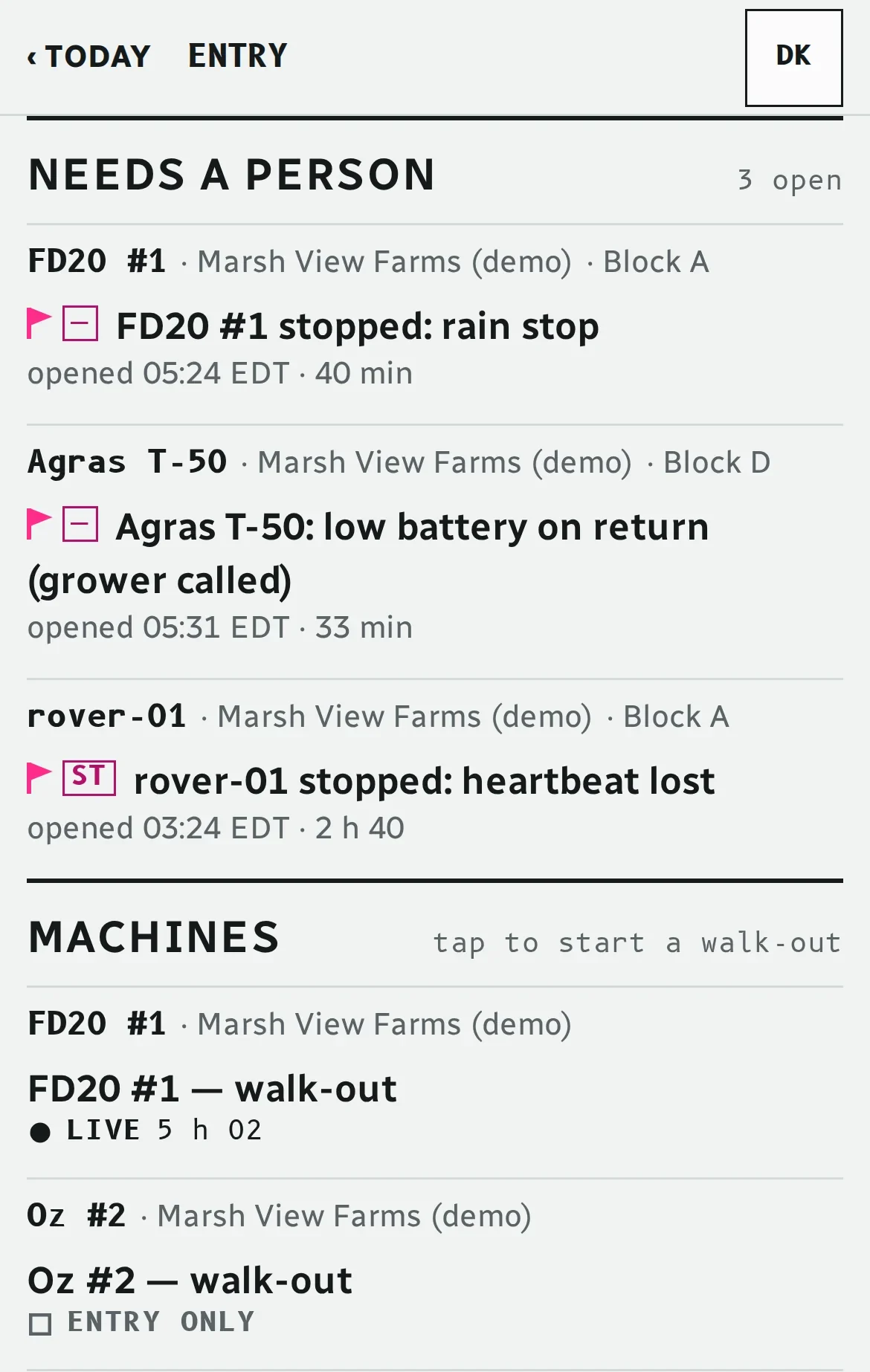
OpenField, our logbook for farm-robot fleets, shows the practice. It is the project where the record is written down most completely, and it is a lab prototype with no funding yet, so the example is the record itself.
- The question was written before the build: can one logbook record what robots from different manufacturers did, where they failed and what the grower must report?
- The measures were fixed in advance: fifteen of them, each computed from the logbook, with its source carried next to every number.
- The work was cut into ten packages, each with the files it owns and its own tests, and the definition of done was three checks anyone can repeat.
- Evidence is dated and sealed: on 17 October 2026 a simulated capture of 8,567 events was replayed into an empty instance and produced the same SHA-256 hash, and the capture is labelled as simulation.
On a client project
The same record is kept from the first day: the open technical questions in the scope, each attempt and its test in the repository, and a short dated log of results and hours.
Who files the claim
The client’s accountant or SR&ED preparer decides what to claim, prepares the claim and files it for the client. INNOVA’s part is the technical record and the answers to the preparer’s questions about it. Tax advice stays with the accountant.
The enhanced credit
Most Canadian-controlled private corporations can earn a refundable investment tax credit at the enhanced rate of 35% on qualified SR&ED expenditures, up to the expenditure limit. For tax years that begin after 15 December 2024, the limit is $6 million a year; it was $3 million for earlier tax years. Qualified spending above the limit earns the basic rate of 15%.
IRAP, RAII and SR&ED on one project
CRA reduces qualified SR&ED expenditures by any government or non-government assistance and contract payments, project by project. Its policy describes government assistance as assistance from a government, municipality or other public authority, whether as a grant, subsidy or forgivable loan. When assistance is repaid later, the repayment generally increases the credit in the year it is repaid.
On the funding side, FedDev Ontario counts SR&ED tax incentives as other government assistance and asks RAII applicants to leave SR&ED-eligible costs out of the application when possible. A project that uses more than one program needs one ledger that shows which money paid for which work. The programs are side by side on funding for AI and software projects, with RAII in Ontario on its own page and NRC IRAP on another.
Questions
Does software development qualify for SR&ED?
Some of it can. CRA looks for work that tries to resolve a scientific or technological uncertainty through a systematic investigation: a hypothesis, tests and conclusions, with evidence kept as the work goes. Computer programming counts as support work only when it directly supports that experimental development.
What is technological uncertainty?
In CRA’s guidelines, it exists when it is unknown whether a result or objective can be achieved, or how to achieve it, because the knowledge available is not enough. That knowledge includes what the business already knows and what is reasonably available to the public.
Which work is left out of SR&ED?
CRA excludes market research and sales promotion, quality control and routine testing, routine data collection, style changes and commercial production, among others. Work that sidesteps an uncertainty with a workaround built from available knowledge does not qualify either.
What is the SR&ED credit rate for a CCPC?
Most Canadian-controlled private corporations can earn a refundable investment tax credit at the enhanced rate of 35% on qualified SR&ED expenditures up to the expenditure limit, which is $6 million for tax years beginning after 15 December 2024. Spending above the limit earns the basic rate of 15%.
Can one project use IRAP and SR&ED?
CRA reduces qualified SR&ED expenditures by government and non-government assistance, project by project. It defines government assistance as assistance from a government, municipality or other public authority, such as a grant, subsidy or forgivable loan. The claim then counts only the costs that assistance did not pay.
