From business processes to measurable AI automation.
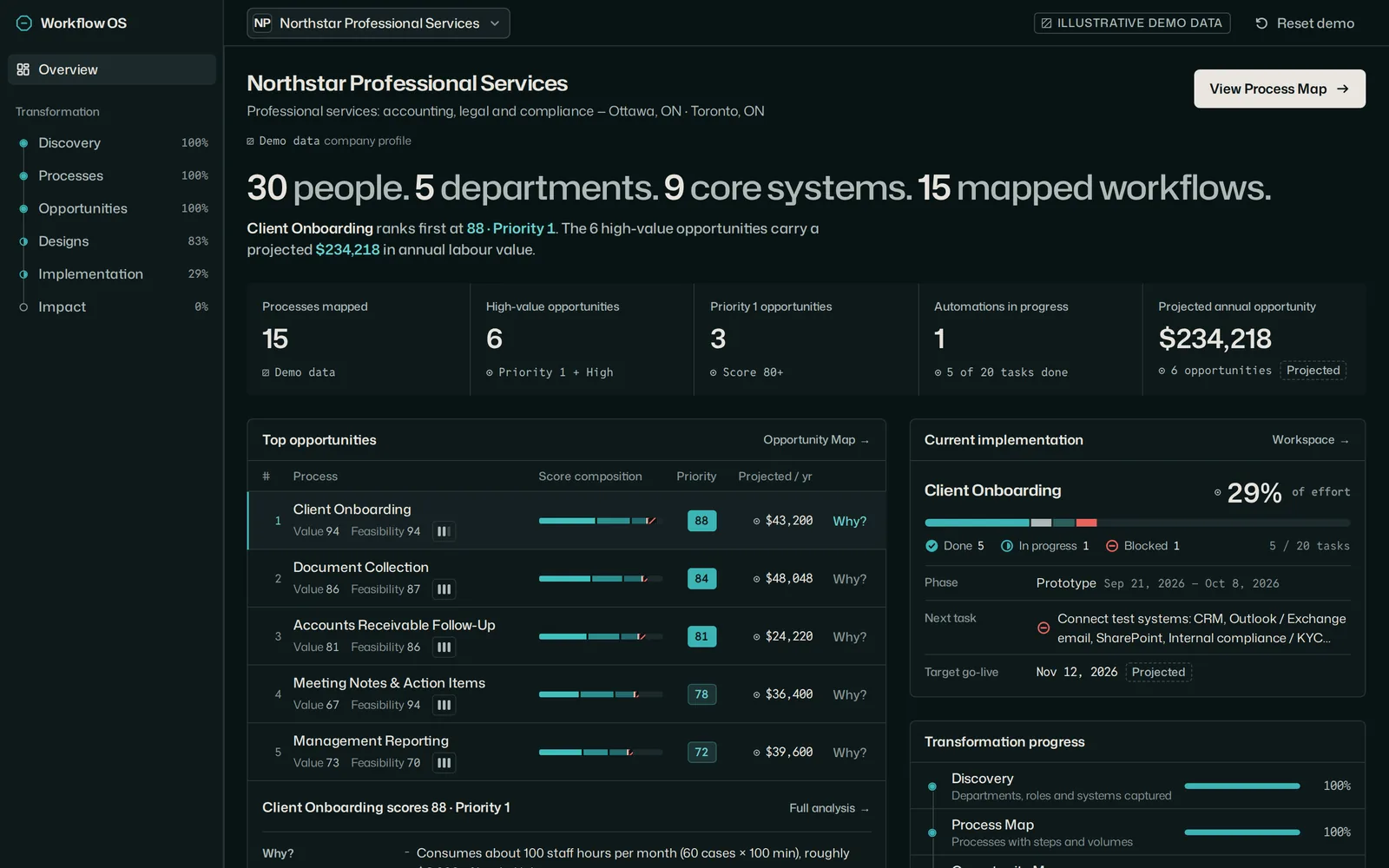
Prototype · company overview of Northstar Professional Services, a fictional 30-person firm, with its automation opportunities ranked by score (illustrative demo data).
Working prototype. Invite-only demo online since 1 October 2026.
You receive a personal link to the working prototype, preloaded with a fictional sample company. The walkthrough takes about two minutes.
Record
INV-04 · Prototype
Technology
React + TypeScript · Deterministic scoring engine (14 factors + risk penalty) · AI process discovery with rules-engine fallback · Architecture recommender (6 patterns, 5 human-control levels) · ROI model · 226 automated tests
Six questions every automation plan has to answer.
Workflow OS answers each one from the company’s own process data, and each answer links to the module that produces it.
What exactly should be automated?
Module 2 scores every process on 14 factors in three groups (value, feasibility, strategic fit), subtracts a risk penalty, and shows the reason behind each number.
Each module hands its output to the next. Risk controls run through all five.
Module 1 of 5
Process discovery
Capture departments, roles, systems and processes by hand, or paste a written company description and review the draft process model the AI proposes.
Company
Departments
Roles
Systems
Processes
Process steps
Pain points
Volume and minutes per case
Module 2 of 5
Automation opportunity map
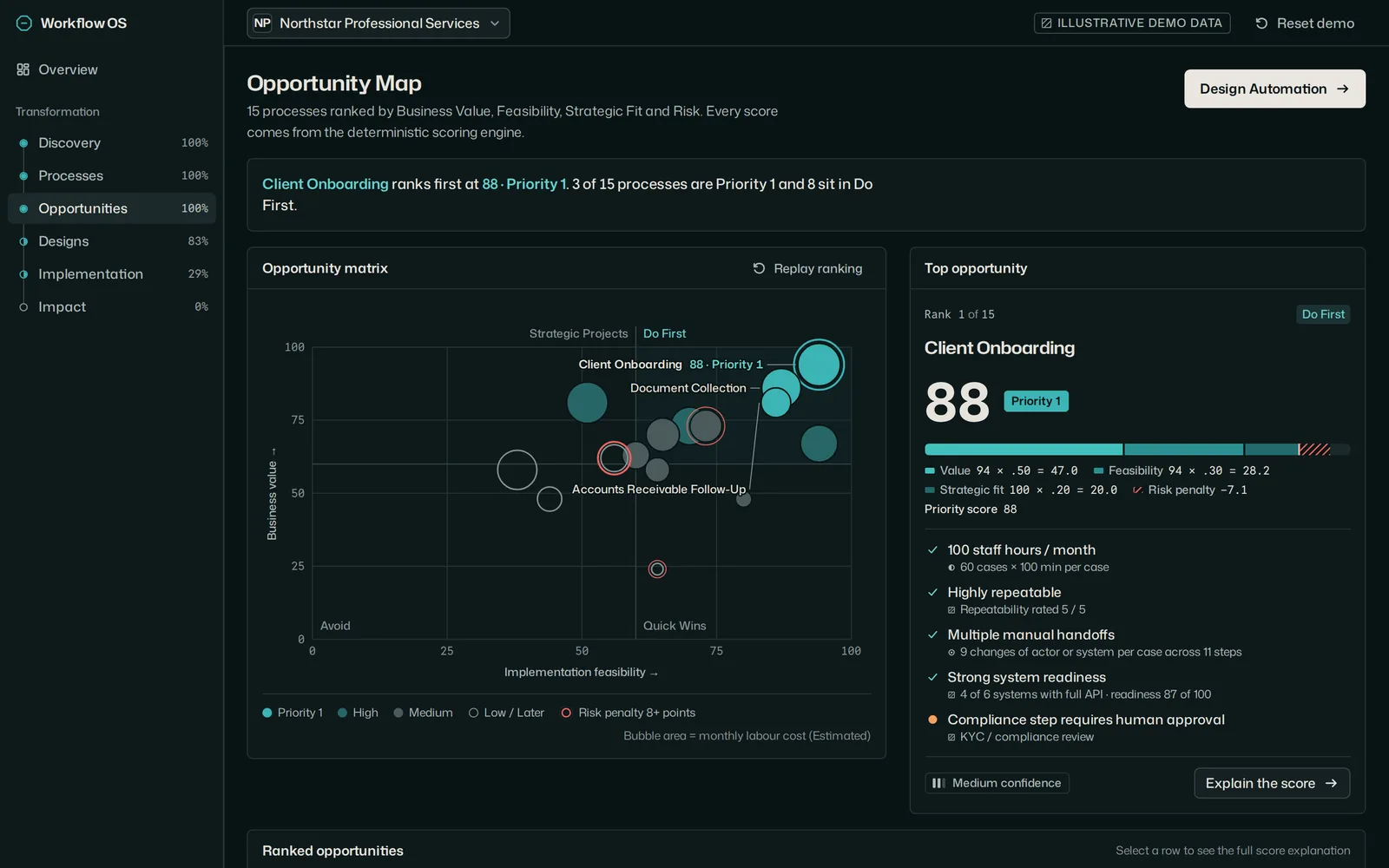
Opportunity Map for the demo company Northstar Professional Services (illustrative demo data). Every score shows its parts.
Score every process on 14 factors in three groups (value, feasibility, strategic fit), subtract a risk penalty, and show the reason and evidence source behind each number.
Priority = Value × 0.50 + Feasibility × 0.30 + Fit × 0.20 − Risk penalty
Value
Time consumed
Volume
Rework
Waiting time
Client and revenue impact
Feasibility
Standardization
Data readiness
System readiness
Rule clarity
Exception predictability
Fit
Repeatability
Scalability
Employee pain
Management priority
Risk penalty
Privacy
Regulatory
Consequence
Change complexity
Module 3 of 5
Automation designer
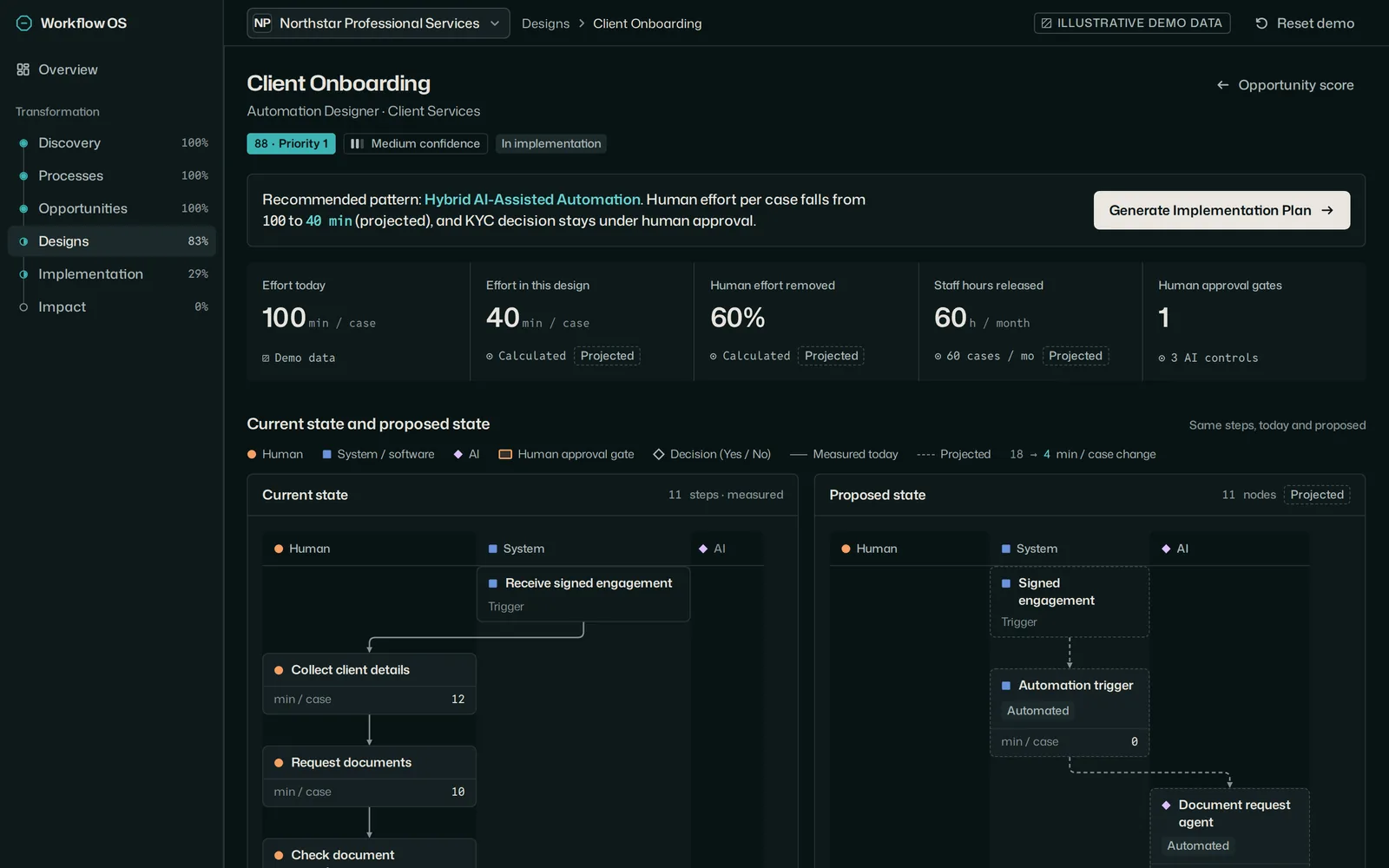
Automation Designer: current state against proposed state, with the human approval gate kept. Illustrative demo data.
Recommend one of six patterns for the selected process, draw its current and proposed flow, and set a level of human control for every component.
Six patterns
Traditional workflow automation
AI assistant with human execution
Bounded AI agent
Multi-agent system
Human-in-the-loop AI support
Hybrid AI-assisted automation
Five levels of human control
Fully automated
Review after execution
Approval before external action
Approval before critical action
Human only
Module 4 of 5
Implementation workspace
Validate
Prototype
Pilot
Production
Optimize
Turn the design into a delivery plan in five phases, with an owner, dependencies, effort, a target date and acceptance criteria for every task.
Tasks
Owners
Dependencies
Systems touched
Milestones
Effort in days
Target dates
Acceptance criteria
Module 5 of 5
Impact & ROI
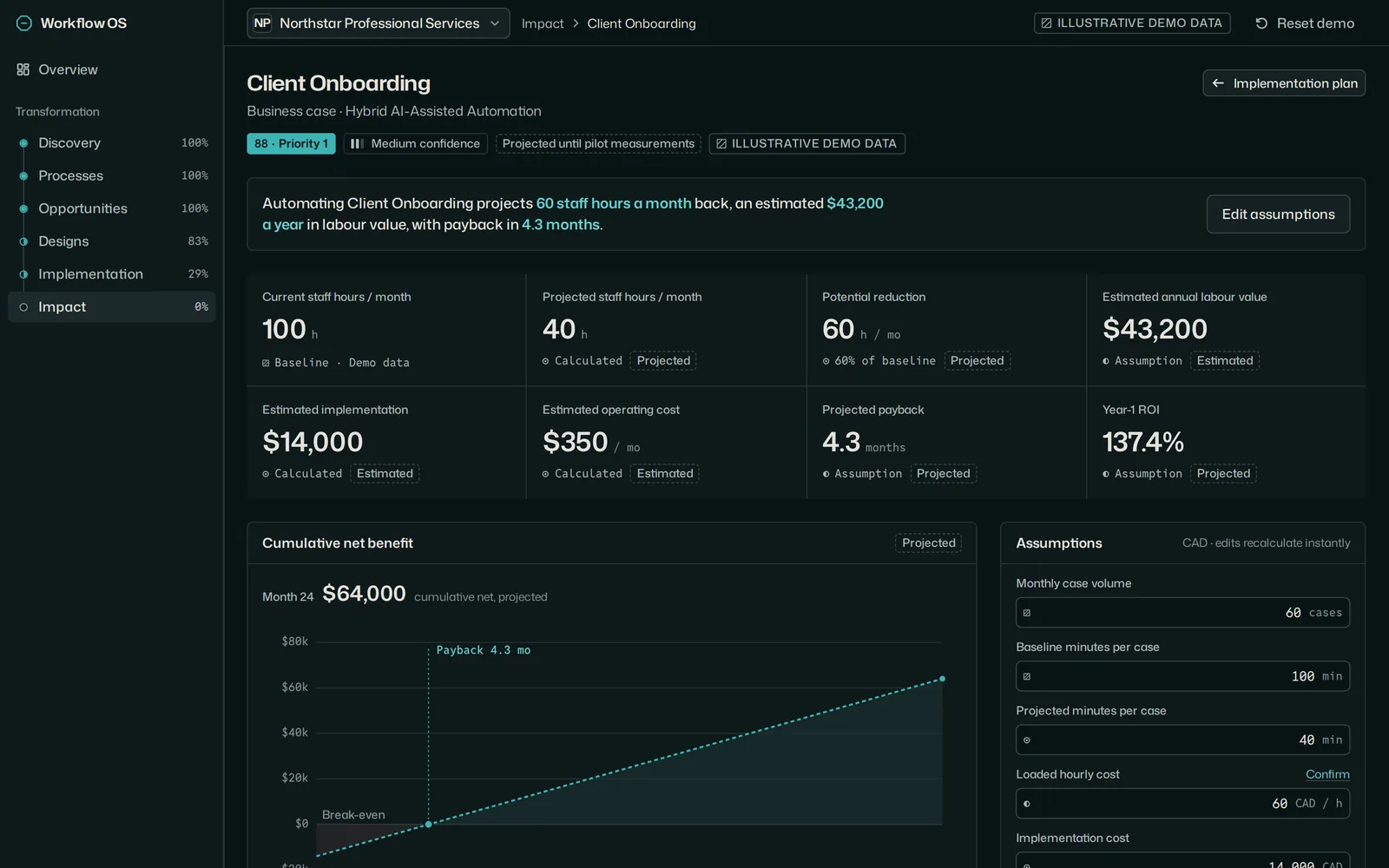
Business case with each number tagged by origin (illustrative demo data).
Project the return from stated assumptions, then record actual results against the baseline after go-live.
Monthly case volume
Baseline minutes per case
Projected minutes per case
Loaded hourly cost
Implementation and operating cost
Payback and Year-1 ROI
Actual minutes after go-live
Actual volume after go-live
Risk and governance · every module
Privacy
Security
Regulatory
Financial
Legal
Reputational
Operational
Model hallucination
Unauthorized tool use
Where Workflow OS ends.
Workflow OS decides what to automate and how. The automations themselves run in the client’s existing platforms or in INNOVA products such as AICRMIUS.
That boundary keeps the planning tool independent of any single vendor, including us.
The demo runs on fictional data. Scoring, design and ROI are calculated without AI. Optional AI discovery sends the description you paste to an external AI model hosted outside Canada; when it is off or slow, a rules engine drafts the process model instead.